Reading the Turned-Away Look
A dog turning its head away can signal discomfort, distraction, or a passing interest. Read the movement alongside the dog’s body, the moment before it happened, and what follows.
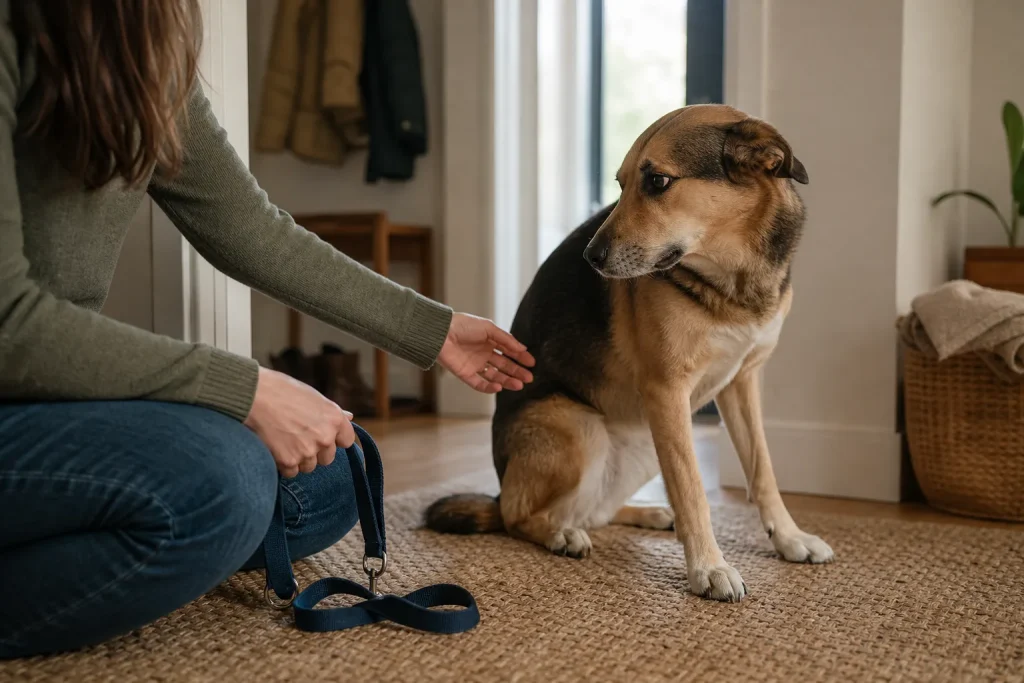
A dog turns its head as you reach for the leash. Before deciding why, notice whether its body stays loose, shifts back, or goes still. The same movement can accompany attention to a sound, a wish to disengage, or discomfort with what just happened.
One glance cannot tell you what a dog feels. A short sequence can tell you more: what the dog was doing, what changed just before the turn, and what the dog did next. Record those visible details rather than assigning a motive.
What else does the body show?
Look beyond the head. Are the ears neutral or pinned back? Is the mouth relaxed, closed, or drawn tight? Does the dog shift weight away, lower its body, tuck its tail, or remain balanced and loose? A head turn paired with a step back or a sudden stillness deserves more attention than a turn followed by relaxed sniffing.
Watch the next few moments, too. A dog might glance toward a hallway sound and then return to sniffing. Another might keep turning away while leaning back. Those sequences are different observations; neither one, by itself, tells you exactly what the dog intends.
Keep the description literal: “turned head, body stiff, hand near collar.” Avoid labels such as “stubborn” or “guilty.” Plain notes make it easier to notice which situations recur.
What happened just before the turn?
The moment before the gesture matters. A hallway noise, a phone camera pointed at the dog, another dog approaching head-on, a brush snagging the coat, or a hand reaching toward the collar can each precede a head turn. Note the trigger you can actually see or hear, then compare it with the dog’s posture and what happens next.
Imagine you are sitting on the floor with a dog who turns its head as you lean closer to clip on a leash. You notice the dog also shifts backward and closes its mouth. You stop leaning in, set the leash beside you, and wait. The dog then steps toward the hallway and sniffs; the observable result is that it moved away from the reach rather than returning to you. That does not establish a reason for the turn, but it does give you a useful next observation: record the sequence and avoid treating the glance as acceptance of handling.
If the same dog instead stays loose and turns toward a sound outside, note the sound and whether the dog resumes its previous activity. The surrounding clues help distinguish a response to the environment from a movement that coincides with an interaction.
How can you tell a pattern from a guess?
After ordinary moments, write down three things: what happened just before the turn, what the head and body did, and what changed afterward. For instance: “Vacuum started; ears moved back; dog turned its head and walked to the hallway.” That records a sequence. “Hates the vacuum” adds an interpretation you have not observed directly.
Imagine you notice head turns on three separate occasions: once when a person reaches over the dog, once when a door closes, and once while the dog watches a bird through the window. Your notes show different preceding events, so grouping all three as one response would be premature. Keep the entries separate and compare what follows each turn: does the dog move away, return to its activity, or remain still?
When a pattern appears, change one part of the setting and keep watching. If turns repeatedly follow a particular sound, note whether they still occur when the dog is farther from it. If they follow overhead reaches, record what happens when a person approaches from the side instead. The point is not to prove a feeling; it is to learn which observable conditions tend to come before the gesture.
When does the sequence call for help?
If a head turn repeatedly appears with stiffness, withdrawal, or stillness during touch, stop treating it as a puzzle to solve in the moment. Note the handling context and speak with a veterinarian if discomfort or pain may be involved. A qualified, humane trainer can help you observe handling patterns without forcing contact.
For everyday notes, keep the entry brief and specific: the setting, the event immediately before the turn, the body details, and what followed. Over time, those observations can help you ask better questions about your dog’s communication without turning a single glance into a diagnosis.
Nearby reading
The Guest Visit, Planned from the Dog’s Corner
Make visits easier to manage by assigning guest roles, simplifying arrivals, and arranging the room so…
Let the Nose Set the Pace
A sniff-friendly walk depends on choosing the right route for the moment. Learn where to pause,…